Showing posts with label guest post. Show all posts

Friday, May 5, 2017

What The Heck Is Lupus, Anyway?

Lupus is a chronic autoimmune disease in which the body's immune system attacks its own tissues and organs. It is not known exactly what causes lupus, but we do know that the immune system is unable to tell the difference between intruders and the body’s own tissues. Trying to do its job, it attacks parts of the body, causing inflammation and creating the symptoms of lupus. It is difficult to diagnose, a challenge to treat, and there is no cure.

It is estimated that lupus affects over 1 in 1000 Canadians.

My friend (and 'blogging megastar', as she likes to call herself), Lisa Walters is one of those people, and she writes about her experiences living with lupus in her blog - Damsel in a Dress. Lisa is hilarious, and she writes in a very funny way about a not so funny topic. Lupus sucks, there is no denying it.

May is Lupus Awareness Month, and so I wanted to help shine some light on this little-known disease. Lisa says, spreading awareness "allows for those of us with the disease to focus more energy on feeling better and less energy on having to explain what lupus is to everyone in the world whose only knowledge of the disease is from an episode of House."

Here is a post that was originally published by Lisa on her blog earlier this year:


How To Explain Lupus To People With Functioning Immune Systems

A question I get asked a dizzying amount is “but what is lupus, Lisa?” Followed sometimes by “and how does it affect you?” It’s not like I go around wearing a sandwich board that says “ASK ME ABOUT MY LUPUS TODAY,” but I am often in social situations where someone hears that I have lupus or I’m being interviewed BECAUSE I have lupus and I write about it, or I have to take out a giant bag of pills because it’s one of three pill times during the day and people notice these things. I also get a lot of emails asking me to explain the disease. Honestly, I probably get asked these questions as much or more than I get asked “will that be eat in or take out?” which I can promise you is a lot.

When I was first diagnosed with lupus I didn’t really know how to explain it to others. I kind of wanted to carry around a set of those little dinky cars in my pocket so when someone inevitably said “Oh, you have lupus? What is lupus?” I could just take the dinky cars out of my pocket and enact some sort of minuscule car crash with a bunch of flips and a car ending up in a ditch and then maybe depending on how I was feeling at a particular moment I would then use a bic lighter to light that car on fire. But that’s not always practical, because some of my dresses don’t have pockets and some people don’t appreciate me lighting toys on fire on their coffee tables. So I’ve become better at using my words to explain what lupus is, what it does to me, and how it makes me feel. And I guess I should share those words with you, the internet, in hopes that more people will understand at a quicker rate so I can go back to not having to explain it in person so often.

WHAT IS LUPUS?

Lupus is a systemic autoimmune disease. What does that mean exactly? It means that my immune system randomly decides to attack my body because hey, why not? Some weird switch went off that made my immune system mix up its signals. Now it thinks that healthy parts of my body are foreign invaders that are trying to kill me. So my lungs could just be hanging out doing their normal breathing thing and my immune system will wake up from a nap and be all like “what the hell is THIS thing? Why is it so big and how did it get in here?! We must kill it!” And I’m like “no please, you’re being super irrational right now. Let’s just sit down and talk this through. This is called a lung and it is meant to be there to keep me alive.” But my immune system won’t have any of it. It shushes me like I’m a naïve child and starts punching the crap out of my lungs. Thinks it’s for my own good. And when it’s finished doing that it turns around and sees my stomach and goes “Okay holy shit! I swear that wasn’t here the last time we looked! What is happening?! We need to kill this too! Kill it with acid or something!” And I tell it to calm down and just breathe but it’s too worked up at this point. It just wants to beat the life out of everything. And when I say everything I really do mean everything. Systemic means whole body. You name it and my immune system will randomly try to kill it with fire.


My immune system is so busy hulking out on the good parts of my body that it has no time or energy to stop the bad stuff from getting in, which gives me a thousand infections. And I use medications like steroids to knock it down a peg and remind it what it’s supposed to be destroying and what it isn’t. And that works for a little while and I have some good days. But my immune system has the memory of a gold fish so out of nowhere it will turn around, see a healthy organ, and freak out all over again.

I guess my immune system is kind of like the Avengers. It tries really hard to protect the world and we all know it means well, but usually by the end of the fight everything is reduced to rubble and a lot of innocent people have had cars thrown at them. Okay maybe that metaphor doesn’t translate perfectly. But you get the point. It’s a shit show.

WHAT CAUSES LUPUS?

Beats me.

No seriously, scientists haven’t really figured that one out yet. We’ll be living on the moon soon but our immune systems are still a complete mystery. They know something has triggered this weird autoimmune response in lupus patients but they don’t know exactly what. Could be genetic. Could be environmental. Could be magic. Could be all three. I am in no way a professional scientist but I honestly think my lupus stems from a really bad bout of scarlet fever I had when I was in grade nine. My immune system has never been the same since then. But again, I’m not good at science. I just know I’ve felt more or less shitty ever since then. Yay!

WHAT IS THE HARDEST PART OF HAVING LUPUS, LISA?

For me, I think the hardest part of having lupus is the fact that I look really healthy on the outside so it’s hard for people to understand just how sick it can make me.

Lupus is considered an invisible illness. Which means that while the Avengers are destroying New York City inside of my body I probably look perfectly fine on the outside. Some might even say beautiful. Those some would probably be me and my mom. Having a disease with its own built in invisibility cloak can make it pretty challenging for people to believe that you are as sick as you actually are. And even though I would be the first person to tell you to stop giving a crap what other people think of you, it can be really hard to be called lazy or to worry that your employer assumes you’re just a slacker if you call in sick. A disease like lupus forces you to spend a lot of time in your head wondering how you are perceived by the outside world.

For example, after having to take a break from working due to an awful flare up, whenever I took a picture of myself smiling or out in public looking like I was having a good time, I always hesitated before sharing it on social media. I know that when someone sees these pictures they will just assume that I’m healthy and faking it, because society seems to have this perception that if you are sick you have to be sick every moment of every day. You can’t have fun and be sick. You can’t smile and be sick. You can’t have any colour in your cheeks (it’s called blush, people) and still be sick. And society says that to me so often that I actually have days when I wake up feeling okay-ish and then immediately feel guilty for not being at work. Even though I know that the reason I feel at all like a functioning human being is because I have been resting. I know that I’m really sick. I know that lupus is really hard on me and that I’m always tired and in pain. I know that I spend way too many nights sleeping in the emergency room hooked up to an iv of morphine to try to keep me from vomiting for just a few hours. Yet if I have half a day of feeling decent I worry that someone will find out and point at me and say “faker!” It’s a really weird place to be. I hesitate before hitting the share buttons on those photos of me living my life but then I upload them anyway, because I remind myself that I am sick and will be sick every day for the rest of my life, regardless of whether or not I’m in bed or out to see a movie with my boyfriend. But I wish I didn’t have to hesitate at all. I wish I didn’t have to keep hearing over and over again all the well-meaning people saying “oh but you don’t look sick.”


So that’s lupus, in a nutshell. I never know how it’s really going to affect me, and it causes more than just physical problems. When you have a rather strange, unpredictable illness it affects way more than just your immune system. It affects your mood, your mental health, your ability to be social and carry on normal friendships and relationships, your career, your finances, and how you see yourself as a member of society. Lupus is a lot of things. It’s really confusing, often scary, and almost always misunderstood. So thanks for reading this far and taking a few minutes to better understand how lupus affects those of us who live with it. And sorry for all of the Avengers metaphors.

 *****

Thank you, Lisa, for allowing me to share your voice here in this space today. I hope that this post helps to inform people about what it is like to live with a chronic autoimmune disease like lupus. We all benefit when we take the time to support each other and learn a little bit about something that people struggle with on a daily basis.

I encourage you all to check out Lisa's blog - Damsel in a Dress. She writes raw and honest accounts of her life and her health struggles, revealing details that not everyone would be brave enough to admit. What I love most about Lisa is that she is as kind as she is funny. She tells it like it is, and whether you have a chronic illness or not, she is downright relatable. 


Follow Lisa at www.damselinadress.ca and find out more about lupus at http://www.lupuscanada.org/

Monday, December 22, 2014

Making the Most of the Holiday Season

Preparing for Christmas and Surviving Enjoying the Holidays

This is a guest post I wrote for another local blogger, Lisa Walters, of Damsel in a Dress. Lisa writes about her life and her struggles with chronic health issues. She writes in a lighthearted, humorous and refreshing way (girlfriend is hilarious!), and I like that!

Lisa wrote to me several weeks ago, describing a little holiday blog project she was working on where she was putting together a compilation of guest blog posts from writers talking about how to survive the holidays with various conditions, illnesses, and other issues that might make the holidays a little more difficult than they should be.

(Read her description here - How to Deck the Halls when you can Barely Crawl: Surviving the Holidays with a Chronic Illness)

Below is my guest blog post, also published HERE.

*****

There is a natural desire to pass family traditions down to the next generation, and I always thought I would do that… until my son, Brennen came along, rocked my world, and changed how we do things, including the Holidays, entirely.

For the first couple of years of Brennen’s life, I would dread going to toy stores. Who am I kidding, I still do. I avoid them at all costs, knowing that there is very little available that Brennen can “play” with. Christmas shopping has become a challenge, and though I try to resist it, every year I inevitably find myself in a toy aisle, tears streaming down my face with the realization, once again, that I am living in a starkly different world. While I dream of wrapping up the one thing my child will adore, the one thing that will attract is attention, ignite his creativity and give him opportunities to play and learn and grow, it is not that easy. Finding products and toys that will work for Brennen is difficult. I look at items, analyze their potential, and ultimately decide that they are not suitable – that he cannot physically manipulate them on his own, and will be a complete waste of money. Sometimes I will purchase the toy anyway, in hopes that some miracle will happen and his skills will improve. Sometimes I just want to feel like any other parent shopping at Toys R Us, who can pick out a present for their child without having to stress about whether or not it will be used for its intended purpose, or be added to the stuff that goes into a closet and never comes out.

Christmas is different with a child with special needs. Brennen can’t write a letter to Santa. He can’t tell me anything that he would like to ask for, or what he hopes to find underneath the tree on Christmas morning. He can’t get up in the middle of the night to exclaim his excitement that Santa has come, and he can’t unwrap his own gifts. I don’t even know how much he understands about Christmas or Santa Claus or traditions or magic, but we do it anyway. We bring Christmas into our home and we celebrate with all of the things that a little boy should have around him – love and light and wonder and joy. We do it for him, and we do it for us, as a family. It is important to carry on with some of the things that meant a lot to us growing up. We love Christmas! I still get giddy thinking about my favourite Christmas songs (so many I can’t pick just one!), favourite Christmas movie (Miracle on 34th Street), and favourite Christmas treats (Mom’s (used to be Nan’s) apricot raisin cake).

My most cherished Christmas memories from when I was a child are never related to a present. They are memories of going to mass on Christmas Eve with my father and grandfather, Dad reading The Night Before Christmas to my sister and I no matter how late it was (literally every year until we moved out), having turkey dinner on Christmas Day with my Mom’s family, and a sing-along at my parents’ annual blow-out Boxing Day party (that is still a tradition today!). My favourite memories revolve around people, family, spending time with loved ones and celebrating the holidays together. This is what matters most to me, and this is something that I can continue with my own little family.

Brennen enjoys the sights and sounds of Christmas. He loves to look at the twinkly lights on the tree, and we have Christmas music playing constantly. He is happy when he is surrounded by people, and he certainly knows that he is loved.

We have started some new traditions. On Christmas Eve, instead of going out, our family and friends now come to our house to see Brennen before he gets tucked into bed for the night. Our schedule of events now includes the Janeway Children’s Hospital Christmas party, Easter Seals Breakfast with Santa, and the Rainbow Riders Live Nativity. These have quickly become our favourite and most anticipated events of the season!

Brennen was a Shepherd in the Live Nativity

We don’t go overboard with gifts. On Christmas morning, we take time to help Brennen unwrap each one, enjoying the sound of ripping paper, and the anticipation of what’s coming next. We focus on the importance of what the holidays are truly about – family and togetherness, kindness and giving, magic and wonder.  

If I were to give advice to parents of children with special needs this Christmas, I would have to say not to put too much pressure on yourself, and don’t expect things to be ‘perfect’. The holidays are stressful for all parents, but our children’s special needs add an extra degree of difficulty. Try not to get caught up in the details, and just enjoy the time with your family. It may not look the way you had envisioned it, and it may not run as smoothly as you had hoped, but it can still be special. It may not be what you had planned, but that doesn’t mean it can’t be awesome! Focus on the positive things, and think of all the things you’re thankful for. Start new traditions, make it meaningful. Find happiness in your child, and that will get you through anything!

Easter Seals Breakfast with Santa, 2014 

 Home 

Saturday, August 23, 2014

Firefly

Firefly is an innovative company that makes postural support seats and mobility devices that let children with motor impairment "participate in all those moments that make family life special".


Firefly also has a Special Needs Blog, to which I am a regular contributor. Each month, they send out a list of "talking points" to their regular bloggers and parents - ten topics they want to get our opinion on. They then turn the answers into articles and blog posts for the benefit of other parents.

Their questions are thought-provoking and inspiring, and they evoke some insightful answers. Questions like "What is the most common lie you tell your children?" and "Tell me something about everyday life that only the parent of a child with special needs would know."

Here are some of my most recent contributions.

http://www.fireflyfriends.com/special-needs-blog/specific/did-she-really-just-say-that-10-comments-that-enrage-parents-of-kids-with-d?utm_source=Blog+-+10+Comments+that+enrage...&utm_medium=Blog&utm_campaign=Blog+-+10+Comments+that+enrage


http://www.fireflyfriends.com/special-needs-blog/specific/whats-the-most-common-lie-we-tell-our-children-with-special-needs?utm_source=Blog&utm_medium=Blog&utm_campaign=Blog+-+Common+lies


http://www.fireflyfriends.com/special-needs-blog/specific/five-things-only-a-parent-of-children-with-special-needs-knows

I am looking forward to the next set of Talking Points. Stay tuned to Firefly's Special Needs Blog, where parents, caregivers and healthcare professionals share their stories, insights and thoughts to inspire each other.


Sunday, August 10, 2014

Teachable Moments

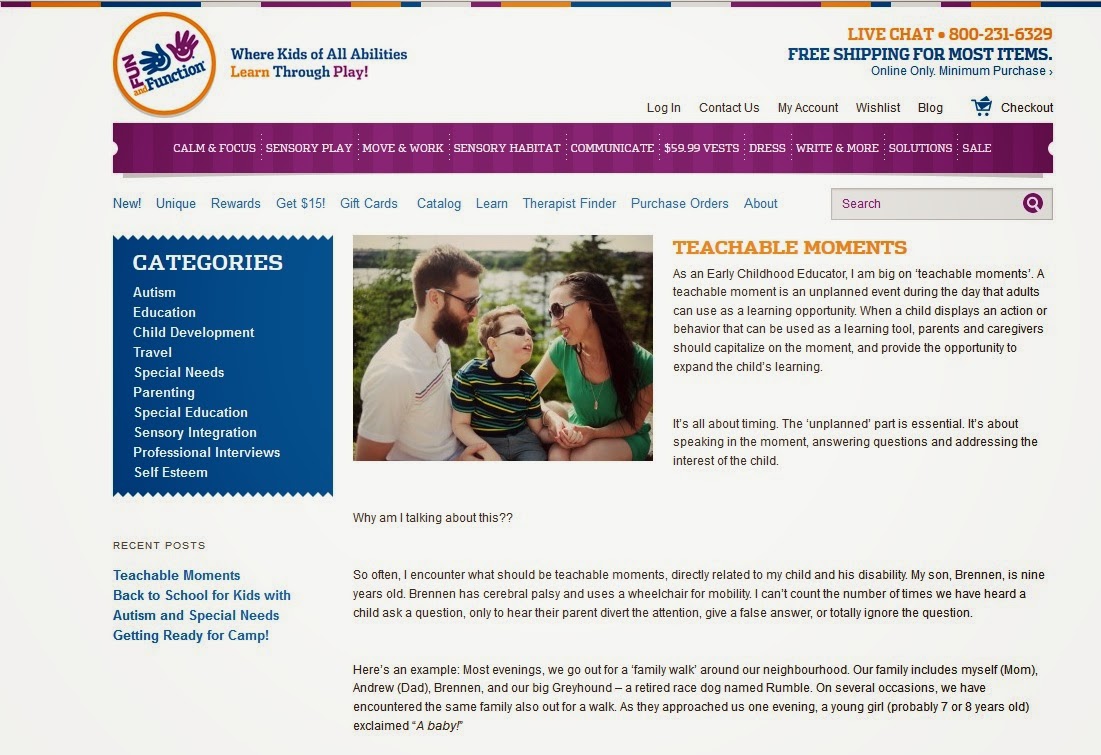
As an Early Childhood Educator, I am big on 'teachable moments'. A teachable moment is an unplanned event during the day that adults can use as a learning opportunity. When a child displays an action or behavior that can be used as a learning tool, parents and caregivers should capitalize on the moment, and provide the opportunity to expand the child's learning.

It's all about timing. The 'unplanned' part is essential. It's about speaking in the moment, answering questions and addressing the interest of the child.

Why am I talking about this??

So often, I encounter what should be teachable moments, directly related to my child and his disability. I can't count the number of times we have heard a child ask a question, only to hear their parent divert the attention, give a false answer, or totally ignore the question.

Here’s an example: Most evenings, we go out for a ‘family walk’ around our neighborhood. Our family includes myself (Mom), Andrew (Dad), Brennen, and our big Greyhound – a retired race dog named Rumble. On several occasions, we have encountered the same family also out for a walk. As they approached us one evening, a young girl (probably 7 or 8 years old) exclaimed “A baby!

Now.. I know she was talking about Brennen. They know she was talking about Brennen. Yet, the mother replies, "Oh, no that's a big dog!"

Lady.. your daughter is not stupid. She knows the difference between a dog and a baby! She was talking about my son. All you had to do was explain to her that he is a little boy in a wheelchair. She obviously has had no exposure to people in wheelchairs, and that’s ok. She’s young. But chances are, she will encounter individuals with various disabilities throughout her lifetime. It is your job to prepare her for this! A few brief words about how some people have trouble walking and need to use wheelchairs would suffice. Maybe explain to her that it does look a little bit like a stroller, but it is actually a wheelchair, for older children. It’s not rocket science.

I get that perhaps she felt embarrassed (it was obvious that we'd heard her child say "A baby!"), and maybe she didn't want us to feel bad, or perhaps she just didn't know what to say. But you guys, please don't lie to your children. Parents are (or should be) their child's greatest influence. They listen to what you say and they hold it to a high regard. They believe what you say is the truth. This lady implying to her daughter that Brennen was a dog is just confusing! Your kids are smarter than that. They deserve better than that.

Children will say funny things, and they will ask strange and often embarrassing questions, but that's all a part of childhood, and all a part of learning. It is our job to answer their questions truthfully, with as much or as little information necessary to satisfy their curiosity.

Some children have great questions! A little boy recently asked me “If Brennen is in a wheelchair, how does he get in bed?” Excellent question. I told him that “We help Brennen out of his chair, help him get his pajamas on and then tuck him into bed, just like your Mommy and Daddy tuck you in at bedtime!” He was happy with that answer, and went on to what he was previously doing.

Another little boy came over to Brennen in the swimming pool one day and asked how old he was, to which Andrew replied that he was nine. The boy thought for a minute and said “He’s small. Is he strong?” Great question. Andrew said “He’s probably not as strong as you are!

A young girl came sauntering over shortly after and asked “What’s wrong with him? Is he tired?” Andrew calmly replied that he wasn’t tired, he was just relaxing in the water, to which the girl retorted, “Why is his mouth open?

The little boy from earlier piped in and said quite matter-of-factly, “So he can breathe!

I love that kid.

My point is that children are naturally going to be curious about anything that is 'different' or new to them. It is our job as parents to educate our children and to prepare them for life and the great big world out there. We must equip them with the tools and the language to be able to ask their questions without being offensive or rude.

When your child notices or asks questions about a person who has a disability, it is an opportunity for you to talk about individual differences. Your response will shape your child’s future attitudes and actions toward people who live with disabilities. Explain that there are actually lots of ways that people are different, but there are also many ways that they are the same.

Teaching your child to be respectful and inclusive of all people is one of the greatest gifts you can give them. Treating others as you would like to be treated is always good advice.

-Julie B

http://funandfunction.com/blog/teachable-moments/

This article was featured as a guest post on Fun and Function - an amazing company started by an Occupational Therapist and Mom of a child with special needs. "We started Fun and Function because we couldn’t find kid-friendly sensory tools that would fit our family’s needs. So we channeled our frustration and turned it into a passion for creating the best sensory toys and tools on the planet."
Check out their catalog and website devoted to making sure children with special needs get the tools they need to succeed.  www.funandfunction.com

http://funandfunction.com/


Monday, March 17, 2014

Turning Point: by Nathan Chaulk

I am excited to extend my blog today to share a piece of writing from a different perspective.  I often write about my own thoughts and feelings about raising a child with special needs, and I have created the 'Tulip Tales' series, where other parents of children with special needs share their stories and experiences.  This will be my first time sharing something from the point of view of an individual with a disability, and it is an absolute privilege.

Nathan Chaulk is a thirteen year old boy with cerebral palsy.  He wrote this essay for his Grade 7 English class.  Each student was asked to write about a turning point in their lives, and Nathan chose to write about his 'Dream'.  Nathan dictated his essay into an app on his iPad, and his mother typed it for him.  His Mom says, "It is amazing to watch him formulate such wonderful ideas and then use technology to assist him.  This truly was an amazing day.  We are forever changed by our experience with the Sunshine Foundation and the generous volunteers that made Nathan's dream come true."

*****

Turning Point Essay

by: Nathan Chaulk

My turning point was when I received a heated swimming pool as my dream through the Sunshine Foundation of Canada.  At first, the Sunshine Foundation did not know if my dream would be possible because it was too expensive.  The pool, the heater, the decking and the ramp cost more than the foundation could cover.  My family and I were very doubtful that the pool dream would be possible.  My Dad encouraged me to think of other ideas.  However, before I knew it, word spread throughout my community and volunteers came forward to help make my dream a reality.  
 
My dream was made possible because of many volunteers.  One of the volunteers was an actual carpenter and he led the group of men to build the deck and ramp.  The Sunshine Foundation agreed to provide for the pool and the heater and my parents provided the wood.  The group of volunteers built the deck.  They made the deck big enough for my power wheelchair.  The pool is 18 feet in diameter and it is 4 feet deep.  
 
The company that installed the pool dropped off water vats to my house one evening.  That made it seem very real.  I was so excited that I was jumping up and down in my chair.  The cost of filling the entire pool was $2000.00.  Once the word spread about this extra cost, the local fire department came to the rescue.  They filled my pool by using the pumper truck.  As they volunteered to fill the pool they were getting some training in how to hook up the hoses to the fire hydrants.  Also, the police department donated the wood for the ramp.  In one day a group of volunteers came together to make my dream a reality.  They built the deck and filled the pool on Saturday and then they built the ramp on Sunday.
 
Through this experience I have made many new friends.  The volunteers who came together that weekend are now a special part of my life.  We love to get together with them.  For example, my family organized a Christmas party for all the people who helped with my dream.  This special group of people is now a very important part of my life.
 
I love to swim.  I feel so free when I am in the water.  I can walk and move freely.  I am also a very good swimmer.  The coach from the Paralympic swim team saw me swimming this year and she thinks that I have the potential to go to the Canada Games as a swimmer.  My pool will allow me to practice my skills while I have fun.
 
In conclusion, my turning point was about more than a pool, it was about the kindness of others towards me.  


*****

Thank you, Nathan for writing this essay and thank you for your willingness to share.  There is certainly a lot we can all learn from your experience.  From the gift of kindness that you received, to the true sense of community that was created around you, it is a wonderful story and a beautiful message.

I hope that you enjoy your pool, and that many happy memories are made there!

-Julie

The Sunshine Foundation is a national Canadian charity that provides individual dreams to children with severe physical disabilities as well as life-threatening illnesses. The positive impact that they have on the lives of these children and their families is immeasurable. 
In a word, they are awesome.  Seriously, awesome.


Tuesday, March 11, 2014

Holland Bloorview

I am honoured to have been invited to write for BLOOM, a magazine and blog created by Holland Bloorview Kids Rehabilitation Hospital.

Holland Bloorview is Canada’s largest children’s rehabilitation hospital and provides specialized programs and clinical care for children and youth with rehabilitation and complex care needs.

Louise Kinross, the editor of BLOOM, is a parent to four children, one of whom has a rare genetic disorder and multiple disabilities. She is also communications manager at Holland Bloorview Kids Rehabilitation Hospital.  Louise was interested in our Little Tulips Family Child Care program, and asked if I would write about how having a child with special needs led me to create Little Tulips.

Click below to read the article I wrote for BLOOM!

http://bloom-parentingkidswithdisabilities.blogspot.ca/2014/03/mom-opens-inclusive-childcare-denied.html


Wednesday, February 26, 2014

Handling the News of Your Child's Diagnosis - Guest Post by Shani Thornton

My hope for this blog is to connect with other parents of children with special needs and to build a supportive network and community. I am honoured to be able to give people a glimpse into my life, in hopes that there will be an increased understanding and awareness of what parents go through when raising a child with special needs.

Today, I am happy to publish an article written by Shani Thornton.  Shani is a certified child life specialist and a full-time Mom. 
Her words were truly a gift for me, and one that I am happy to share with you.

Handling The News of Your Child’s Diagnosis 


You are sitting in the doctor’s office and you can sense that you are about to receive some life changing news. Maybe you are pregnant, so you gently place your hand on your belly to let your baby know that you are close, or you are holding your squirmy toddler and softly singing in their ear while rocking them with ease. You might have had to leave your bedside post of holding your child’s hand while they are hooked up to monitors and on a breathing machine.

When the doctor walks in, your body is fueled with adrenaline. They start to give you information about a diagnosis, prognosis and treatment plan. The emotions take over and there is a physiological change occurring to your body. Tears are streaming down your face, you have difficulty breathing or speaking. There is a ringing in your ears, you may feel nauseous and your head is swirling with jumbled thoughts and information.

What is happening? What did they just say? You are absorbing some of it, but you know it’s not all sinking in.

You look around and try to grasp a sense of reality while knowing that your entire world has been flipped upside down. There is feeling of isolation and that no one has experienced this before.

You leave the meeting holding medical pamphlets and feeling beaten down; red faced, puffy eyes, still trying to catch your breath from the bomb that was just dropped on you.

If you are with your companion then you are wrapped into their arms, hoping that with a big squeeze, this nightmare is just that, a nightmare and you will awaken soon to your normal life.

If you are alone, then you are on the phone calling your number one. When you hear their voice, you break down crying uncontrollably and barely able to speak. The words do eventually make it out and hearing yourself say it makes it hurt even more.

Where do you go from here? How can you envision your future when it has been completely altered without you causing it?

Oh no, that thought has now allowed the feelings of guilt to take over. You start the blame game and the finger is pointing directly at yourself. This is just too much. You can’t do this, this isn’t happening.

Then you feel your baby kick, or hear your toddler make a noise or you go back to your bedside post and see your beautiful child fighting for their life.

You have to do this. You are your child’s voice and protector. The unconditional love is the driving force to push you forward.

We got your back

As a child life specialist, our role is working with pediatric patients and their families, for their psychosocial and developmental needs. We are there to provide support, empathy, preparation and play. We help them find a sense of control and teach advocacy skills in this very complicated medical world.

I thought it might be helpful to share what to expect after a diagnosis and some healthy ways to cope.

  • Entitlement to Have and Express Your Feelings – You are going to have a roller coaster ride of emotions. The feelings of self-doubt, denial, guilt, anger, sadness and loss are just a few of the biggies. It is okay to have all of these feelings and more. Share them with someone you trust, write them down or hear yourself say them out loud. Your body can only hold so much. By suppressing your emotions they will eventually spill out when you least expect it. Release them and you will feel more balanced and better equipped to take care of yourself and your child.
  • Searching Online- One of the first things that you may want to do is get on your computer or smart phone and start looking up medical information. It will be difficult to filter the facts from fiction and also what would be suited for your child’s specific diagnosis and care plan. I would suggest finding out if there is a medical librarian or family resource center at your hospital. They are trained to help you find the appropriate, accredited information without getting lost in the nonsense.
  • Loss of Control- In the beginning there will be a HUGE sense of loss of control. You did not cause this and you did not want this for your family. There will be many days that you are overwhelmed and feel like someone else is steering the wheel for your life. When this happens start to find the small decisions that you still have control over. Small choice making can help you feel like you are in better control of the whole situation.
  • Transitions- There will be many changes that will occur. Your job, home, finances, vehicle and even your day-to-day routine can be affected. This can become very stressful and burn you out quickly. If you need help, ask for it. There are wonderful programs, professionals and neighbours who would all be willing to help. It may be as simple as bringing over a cooked meal twice a week or setting up family meetings with the doctors to clarify information.
  • Support System- Start to surround yourself with supporters. At first you may think that all of your friends and family members will be able to help, relate or even just validate your feelings. Unfortunately that is not always the case. You may find that some of the best people to have on your team are strangers who are going through the exact same thing. Joining a support group in town, talking to other parents at therapy/doctor appointments or finding a community site on social media may be the place to look. You may even decide to start-up your own blog; this could be a great way to release feelings, find veteran parents and even give tips on what has been working for you.
  • Organization- This may not be your strong suite, but it soon will be. With all of the health insurance information, medical history and schedules, you will be very lost and overwhelmed if there isn’t some organization to keep it all in line. Purchase a calendar, note pad or use your electronic device to store all of this information, so it is readily accessible. Writing down questions and concerns as they come up will also help you to remember and bring up when meeting with the medical team.
  • Me Time- The juggles of work, kids, household upkeep and now the new health diagnosis for your child, can put you overboard. Find a healthy way to release stress and commit yourself to it. Maybe it is working out, girl’s night or just taking a drive alone. Do something that will help you stay rejuvenated. There should be no feelings of guilt, as you will be a better parent to your child if you take care of yourself first.
  • Sibling Involvement- Siblings play a very important role. They should be included and told what is happening. If you struggle with ways to explain it, reach out to a professional, such as a child life specialist, who can help assist you. Having them join a sibling support group is also a wonderful way to help them express their thoughts and feelings, process what is happening and feel like they aren’t the only kid going through this.
  • You Are the Expert- You will be encountering many medical and educational professionals. They are experts in their specific field, but they are not the experts of your child, you are. You will know your child’s likes/dislikes, triggers/calming methods, and preferences in food, clothing, touch, people, sounds and more. Keep that all in mind when communicating with the team. Speak up and advocate for your child, your voice is incredibly important and needs to be heard.

This is a different path in your life than you thought you would be on, but just know that you are not alone. There are other parents that have already gone through this phase, are going through it now or will go through it. You will still have that amazing relationship with your child. You will teach them so much and at the same time you will learn and grow from them.

*****

Shani Thornton is a wife, mother and author of “It’s Time For Your Checkup: What to expect when going to a doctor visit.”
She currently lives in New York with her family and remains active in the child life field while leading workshops for parents and caregivers.
Read more from Shani on her website Child Life Mommy: Tips from a Mom and a Child Life Specialist

Sunday, February 23, 2014

28 Days of Play


Rachel Cedar from You Plus 2 Parenting has combined 28 writers to talk about the challenges of playing with your kids in her "28 Days of Play" Series. She reached out to notable bloggers, published writers, moms & dads, thinkers and seekers and asked an important question:  Do you play with your children?”

You can read my response HERE.  (I could have said so much more, but was limited to 300 words!)


http://www.youplustwoparenting.com/readers-share-their-stories-meet-julie/


Thank you, Rachel, for inviting me to be a part of this important discussion!

I would love to hear from other parents of children with special needs.  How do you play with your kids?